Let me start with a confession.
I use AI to write my blogs.
There. I said it.
Not just to check grammar or correct a spelling mistake. I use AI to brainstorm. I use it to explore ideas. I give it thoughts that are still half-formed and ask it to help me make sense of them. I use it to find better words, experiment with different sentence structures, challenge an argument and sometimes tell me that what I thought was the point of a story isn't actually the point at all.
A fair amount of the vocabulary and sentence structure in my published writing has therefore been influenced by AI. I still edit and finalize everything before I publish it.
Which raises an obvious question.
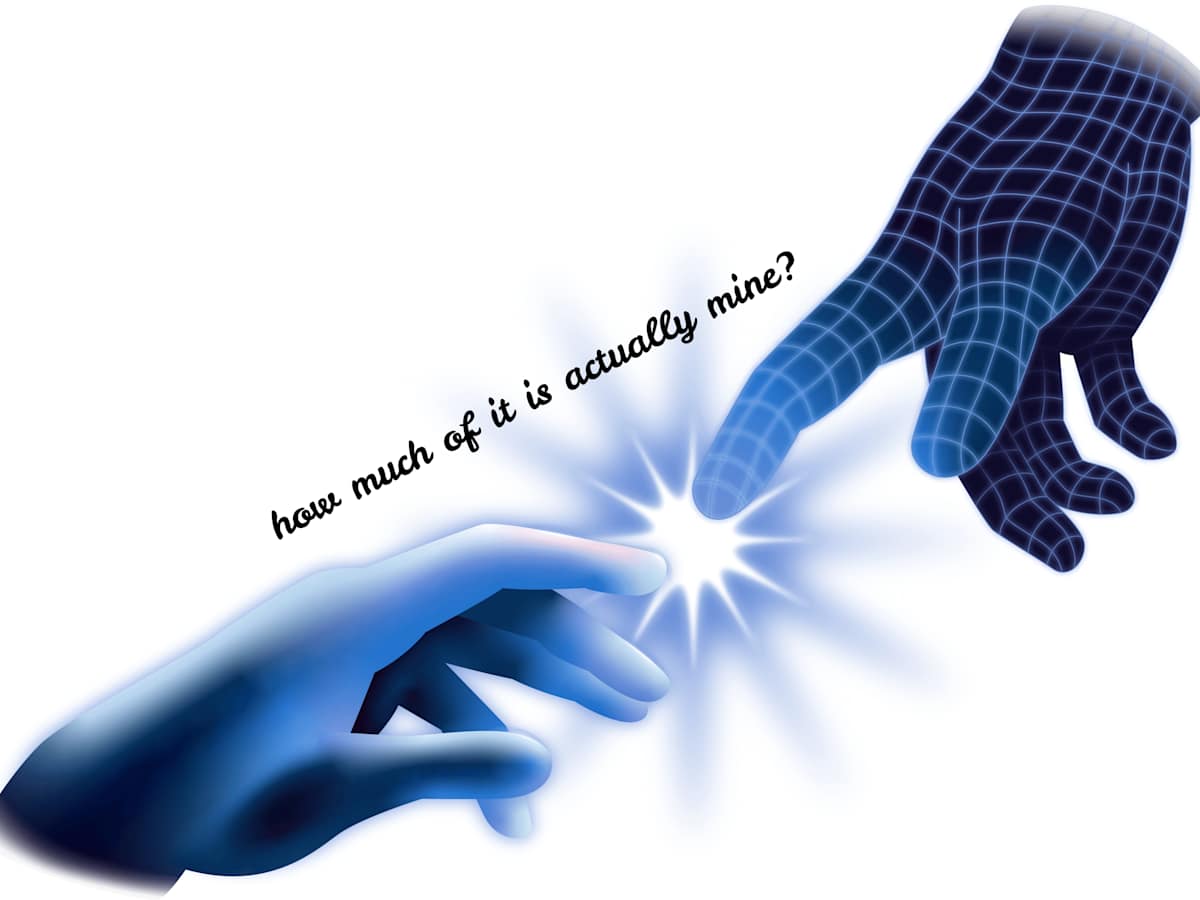
If AI helped me write it, how much of it is actually mine?
I've thought about this quite a bit.
And I've come to a conclusion that is perhaps less straightforward than either "AI wrote it" or "AI didn't write it."
I think the answer depends on what you give the AI in the first place.
It starts with what I bring to the conversation
I rarely begin with:
"Write me a blog about scarcity mindset."
That would probably give me a perfectly competent article about scarcity mindset. It might even be a very good article. But it would probably sound like an article about scarcity mindset.
Instead, I might start with something that happened to me. A memory. Something someone said. An uncomfortable realization. A contradiction I've noticed in myself. An experience that has stayed with me for years without me quite knowing why.
Sometimes I don't even know what the central idea is when I begin. I just know that something is bothering me, interesting me or making me think. I put that into the conversation.
Then the interesting part begins.
The AI can help me pull the thread.
- It can ask, in effect: Is this really what you're trying to say?
- It can show me another interpretation.
- It can connect two thoughts that I hadn't connected.
- It can suggest that an anecdote I thought was central is actually supporting a much larger idea.
- It can help turn a collection of observations into an argument.
And sometimes it simply gives me a sentence that says what I was trying to say but couldn't quite articulate.
That last part is where AI is particularly useful to me.
The quality of the writing starts with the quality of the thinking
I've always thought that AI output is heavily influenced by the quality of what you give it.
I would phrase that more carefully now. It isn't really about the quantity of "data" you feed an AI.
It is about the quality of the thinking and context you give it. Give it something vague and generic, and you are likely to get vague and generic prose. Give it a real experience, specific details, a clear intention and some emotional truth, and the possibilities become very different.
Consider the difference between saying:
"I used to have a scarcity mindset."
and telling the story behind it.
The small things you remember. The choices you made because you had learned that resources could disappear. The food you couldn't assume would still be there later. The opportunities that once felt fragile.
The way those experiences can remain inside you long after your circumstances have changed. Those details are not something I discovered by asking AI to write about scarcity.
They are part of my life.
AI can help me find the language to describe them. It cannot make them my memories. And that matters to me.
What AI actually does for my writing
There are three things I find particularly useful.
1. Vocabulary and rhythm
Sometimes I know exactly what I want to say, however AI is very good at taking that thought and giving me several ways of expressing it.
It can tighten a sentence. Remove unnecessary words. Change the rhythm. Suggest a word that fits better. Or simply show me that a sentence I've written is doing too much work.
I don't automatically accept the suggestion.
Quite often I don't.
But seeing the alternatives helps me decide what I want to say.
2. Structure
This may be even more valuable.
When you're writing from personal experience, it is very easy to assume that because something happened to you, the reader will automatically understand why it matters.
They won't.
An AI can help identify the structure buried inside the material.
Perhaps the story is really:
experience → tension → realization → insight
rather than simply a chronological account of what happened.
It can help me move from an anecdote to an idea and then back to something personal.
The structure becomes clearer.
The thinking becomes clearer.
And sometimes, once the structure becomes clear, I realize that the article I thought I was writing is actually a different article.
3. Idea expansion
This is another area where I find AI useful.
I may start with a thought such as:
"Success doesn't automatically remove a scarcity mindset."
I can ask AI to explore that thought from different angles. It might surface psychological, behavioral, financial or emotional interpretations.
Some will be useful. Some won't. Some might make me think, "I hadn't considered that."
And some might make me think, "No. That's not what I believe at all."
Both responses are useful.
Because the objective isn't to get AI to decide what I think.
It is to give me something to react to.
And that is where I think my authorship lives
This is probably the most important part of how I see AI-assisted writing.
My authorship doesn't live only in the individual sentences. It lives in what I choose to keep, cut, sharpen or reframe.
The AI can suggest a beautiful sentence. I can reject it because it doesn't sound like me. It can give me a powerful conclusion. I can reject it because it is more dramatic than the truth.
It can propose an interpretation of something that happened to me. I can reject it because it isn't what I actually believe.
And sometimes the AI gives me something that is technically better writing but worse thinking.
Good writing isn't necessarily writing that sounds impressive.
- Sometimes a simpler sentence is more truthful.
- Sometimes an awkward detail is more important than an elegant metaphor.
- Sometimes the most powerful thing you can say is less dramatic than what an AI might naturally suggest.
I have to make that judgment.
AI can make you sound wiser than you are
This is probably one of the risks of using AI for writing.
It is extremely good at making ideas sound coherent. It can take a messy thought and turn it into something that sounds profound. That can be dangerous.
Because something sounding profound doesn't make it true.
It is very easy to read a beautifully constructed paragraph and think, "Yes, that's exactly what I mean."
Except sometimes it isn't.
The sentence has simply sounded better than the thought deserved.
That is where the human editor becomes important.
I need to recognize when AI has improved my expression and when it has quietly changed my meaning.
I need to be willing to say:
"No. That's not me."
Even when the alternative sounds better.
Perhaps especially when it sounds better.
AI can create emotional plausibility. I provide emotional truth.
This is another distinction I've come to appreciate. AI has absorbed an enormous amount of human language.
It can write about grief.
Ambition.
Failure.
Love.
Regret.
Scarcity.
Hope.
It can make those emotions sound remarkably convincing.
But convincing language isn't the same as lived experience.
When I write about something that actually happened to me, the significance of that experience existed before I started talking to an AI about it.
The memories are mine. The contradictions are mine. The things I regret are mine. The things I'm proud of are mine. The values I bring to the interpretation are mine.
AI can help me construct the language around those things.
But it doesn't own the experience.
And perhaps more importantly, it doesn't have to live with the consequences of what I choose to say about it. I do.
So I don't really see AI as a co-author
I think of it more as a very fast, very well-read editor who never gets tired of iterating.
- An editor who can give me ten alternative sentences in a few seconds.
- An editor who can help me test an argument from different directions.
- An editor who can tell me that the middle of my article is losing focus.
- An editor who can help me find the word sitting somewhere at the edge of my vocabulary that I couldn't quite reach.
- But an editor doesn't decide what my life means to me.
And that's how I prefer to use AI.
I don't ask it to generate my stance. I use it to clarify a stance I already hold.
The center of gravity remains my own history, observations and values.
There is another reason I use it this way
Writing has always involved some form of collaboration with tools.
We use spell checkers, dictionaries, thesauruses, editors, search engines, grammar tools. We don't generally consider the existence of those tools to mean that the resulting writing doesn't belong to us.
AI is obviously different.
The scale of its contribution can be much greater.
It can produce entire paragraphs, structures and alternative arguments.
That makes the question of authorship much more interesting.
But perhaps that is exactly why we need to become more deliberate about what authorship means. If I simply tell an AI what topic to write about and publish whatever comes back, I would find it difficult to call that entirely my writing.
If I give it my experiences, my thinking and my interpretation, use it to explore and sharpen those ideas, critically evaluate what it produces, rewrite portions of it and take responsibility for the final piece, I see the relationship differently.
The tool has contributed significantly.
But the judgment remains mine.
Which brings me back to the question
Who wrote this?
The honest answer is:
Both of us contributed to the words.
But we didn't contribute the same things. AI contributed language, possibilities, structure, alternatives and speed. I contributed the experiences, the questions, the memories, the beliefs, the context and the judgment about what is true.
And then I made the final choices.
- What stays.
- What goes.
- What gets softened.
- What gets sharpened.
- What gets completely rewritten.
- What I am willing to put my name behind.
That last part matters.
Because ultimately, I am the one publishing it.
Why this needs to be told?
Most readers wouldn't know how much AI was involved in producing my blogs.
But I don't think hiding it makes sense. AI is becoming part of how many of us think, work and create. Pretending otherwise doesn't make the conversation more honest.
So yes, my blogs are written with AI assistance. The ideas and experiences originate with me. AI helps me brainstorm, explore, structure and express them.
I edit, challenge, reshape and finalize what gets published.
I'm not claiming that every sentence originated in my head. I am claiming something different.
The thinking behind the writing is mine, and I take responsibility for the writing that carries my name.
Perhaps that is what authorship looks like in an age where the tools available to us are changing faster than our definitions of creativity.
AI helps me find the words.
I decide what those words mean, whether they are true, and whether they deserve to carry my name.